
Jack Hayes
2026-11-12 
Is Your Referral Program Working? How to Measure Success
We all know that word-of-mouth marketing is extremely valuable, but do you know exactly how valuable? When you spend money on something like a Google Ads campaign, it’s a more straightforward process to calculate your Return on Investment (ROI). Yet, when it comes to customer referrals, most businesses don’t even think about ROI.
If you’re giving away discounts or gift cards to encourage referrals without tracking the data, you could be overspending on incentives or severely under-utilizing your marketing channel with highest ROI potential.
Let’s break down how to measure the success of your referral campaigns and why they can consistently deliver the highest ROI of any marketing channel.
Quick FAQ: The Core Metrics
For a quick overview, here are three important metrics to consider when evaluating your referral program's success:
Customer Acquisition Cost (CAC): Referrals lower your CAC because you only pay the incentive when a new sale is actually made, unlike paying for clicks on Facebook or Google.
Lifetime Value (LTV): Referred customers typically have a substantially higher lifetime value, meaning they stay loyal longer and spend more money over time.
Conversion Rate: Referred leads close much faster than cold leads because they arrive with built-in social proof and trust.
Why do referral programs consistently deliver the highest ROI?
The primary reason referral programs generally have a massive ROI is that they operate on a purely pay-for-performance model.
When you run traditional paid advertising, you’re usually paying for impressions and clicks, trying to acquire cold leads. A user might click your ad, look at your website, and bounce, costing you $10 for increased brand awareness. With a structured referral program, you only incur a marketing cost (the reward or discount) after the new customer has actually converted and paid you. You’re eliminating wasted ad spend entirely, ensuring every marketing dollar directly correlates to closed revenue.
How do you calculate the Customer Acquisition Cost (CAC) of a referral?
Customer Acquisition Cost is the total amount of money you spend to acquire one new paying customer. For a referral program, the math is simple and straightforward: it’s the total cost of the incentives given out, divided by the number of new customers acquired.
For example, if your "Give-and-Get" program rewards the referring customer with a $25 credit and gives the new customer a $25 discount, your CAC is exactly $50. If your average customer spends $500 with you, paying a guaranteed $50 to acquire them is an exceptional, highly scalable ROI.
Do referred customers actually spend more money?
Yes. Studies consistently show that referred customers are more profitable than non-referred customers. Because a trusted friend recommended your business, the new customer skips the usual early stage of skepticism associated with evaluating a new brand.
This transferred trust leads to higher initial purchase values, fewer price negotiations, and a much stronger chance that they’lll become repeat buyers. When you calculate the ROI of your referral program, you need to factor in this increased Lifetime Value (LTV). You’re not just acquiring a new customer cheaply; you’re acquiring a better customer.
What’s the biggest mistake businesses make when measuring referral ROI?
The biggest mistake you can make is relying on manual tracking, spreadsheets, or misleading "How did you hear about us?" intake forms.
If you rely on your front-desk staff to ask customers who referred them or keep track of referral program rewards on their own, your data will inevitably have some flaws. Customers forget details, your staff gets busy and overwhelmed, and rewards can go unpaid. One mistake in that process can be a huge financial loss. When someone doesn't receive their promised rewards, and has to follow up on what they’re owed, they’ll probably stop referring people altogether.
Identify Your "Promoters" to Maximize Conversions
A well-oiled referral campaign is the most valuable, highest return on investment asset your business can build. It drives down your acquisition costs while bringing in high-trust, high-spending customers that are more likely to come back after their first visit.
The last piece of this ROI puzzle is maximizing your referral program’s conversion rate, so you don’t waste time and resources asking the wrong people to participate. So, how do you know exactly who to ask? By sending Net Promoter Score (NPS) surveys to identify your "Promoters" (the customers who score you a 9 or 10), you eliminate the guesswork. Instead of awkwardly asking every single customer for a favor, you just send your referral incentives exclusively to the people who have already told you that they’re thrilled with your service. Targeting your known advocates before making the ask is the absolute best way to guarantee your referral engine converts at maximum capacity.
Build Your Referral Program with The Right Tools
To build a referral engine with a sky-high conversion rate and ROI, you need a system designed specifically to identify your biggest fans first.
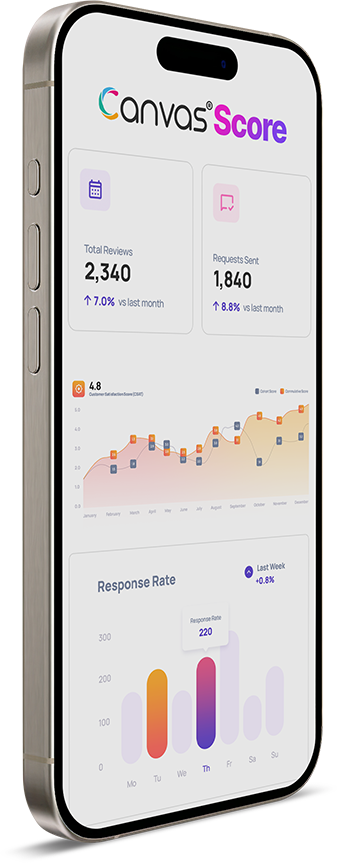
Here’s how Canvas® Score helps you maximize your referral conversions on autopilot:
Identify Promoters with NPS Surveys: Sends Net Promoter Score surveys to your customers, then pitch your referral program exclusively to happy advocates.
Seamless System Syncing: Canvas® Score integrates directly with your existing software or CRM.
Custom Referral Campaigns: Easily build tailored "Give-and-Get" reward structures.
Text & Email Delivery: Deliver your custom referral links directly to your Promoters via text message and email.
Stop leaving referral revenue on the table. Start your 14-day free trial with Canvas® Score today and turn your happy customers into your highest ROI marketing channel.
Canvas® Score, the latest innovation from Roya.com — trusted by thousand of healthcare practices

Canvas® Score is a proprietary review & referral automation platform designed and developed by Roya.com
© 2026 Canvas® Score | All Rights Reserved