
Jack Hayes
2026-07-17 
How Many Google Reviews Improve Your SEO?

It’s one of the most common questions about Google reviews: "What’s the magic number? How many Google reviews do I need before my business starts ranking higher in search results?"
It’s tempting to aim for a specific benchmark, where you feel like you have enough reviews to look credible and for the SEO floodgates to open up. However, Google and other AI search engines don’t structure their algorithms like a simple checklist.
The truth is, there is no universal "magic number." Instead, the SEO impact of your reviews is mainly determined by three key factors: Volume, Velocity, and Context.
Here’s how Google calculates the SEO value of your reviews and how many you actually need to outrank your local competition.
Key Takeaways
The Competitor Benchmark: You don't need a million reviews; you just need more recent high-quality reviews than the competitors ranking above you in your specific local market.
Velocity Beats Volume: A steady stream of 5 reviews a month provides stronger SEO signals than a competitor only getting a few every other month, even if they have more total reviews from the past.
The 10-Review Minimum: While there is no maximum, having fewer than 10 reviews often prevents your star rating from displaying consistently across Google’s search properties and widgets.
Keyword Density: The number of reviews matters, but the words within those reviews (long-tail keywords) are what actually help match you to specific user search questions.
1. The "Competitor + 10" Rule
Search Engine Optimization is kind of like a grading curve. For example, if you’re a local dentist, Google isn't comparing your dental practice to national brands; it’s comparing you to the other similar dentists in your market.
If you’re a plumber in a small town where the top-ranking competitor only has 15 reviews, getting to 25 reviews will give you a massive SEO advantage. But if you’re an optometrist in downtown Chicago and the top three clinics have 600 reviews each, hitting 50 total reviews won't move the needle much.
The strategy: Search for your primary service and your city. Look at the top three businesses in the Google Map Pack. Take the highest review count among them, add 10%, and make that your initial target number.

2. Velocity: Consistency Matters More Than Total Volume
A lot of businesses try to run what’s called a "review push”. They make a temporary consolidated effort to get 50 reviews in a couple of weeks, and then never ask for a review until their next push. To Google and AI engines, this looks suspicious.
Modern algorithms now value Review Velocity: the steady, continuous rate at which new reviews are published online. A business that gets two new reviews every week is viewed as highly active, relevant, and currently providing good service. A business with 500 reviews that hasn't received a new one in 6 months is viewed as potentially inactive or declining in quality.
To maintain your SEO rankings, your review acquisition cannot have an end date or end number. It has to be an ongoing, automated process.
3. The Power of Keywords Inside Reviews
When evaluating your reviews, don't ignore what the reviews actually say. Bots crawl the content of your reviews to understand exactly what services you offer and how well you perform them.
If 40 people leave a review that simply says, "Five stars, great place," you’ll still get a boost in authority. If 40 people leave reviews that say something specific like, "Dr. Smith is the best for dry eye treatments and helped fit me for specialty scleral lenses," now you’re feeding search engines highly specific, long-tail keywords. This will be a huge boost when a user is searching for help with their dry eye symptoms.
4. Taking SEO On-Site
Generating reviews on your Google Business Profile helps your local Map Pack rankings, but you can double that SEO value by embedding those reviews directly onto your website.
When you display a constant stream of fresh, user-generated content on your homepage, search engine crawlers see your website as active and frequently updated. Also, as an added bonus, when users spend time reading reviews on your site, this reduces your "bounce rate", which is another metric Google uses to help determine search rankings.
The Canvas® Score Solution: Never Stop Growing
The problem with trying to hit a specific number of reviews is that the finish line is always moving ahead. Google and AI search engines are scanning the entire web for the most recent and relevant data they can find.
To win at local SEO in your market, you can’t rely on manual review growth. You need an automated engine that consistently generates fresh data for you.
Here’s how Canvas® Score helps you dominate local search:
Automated Review Collection: Put your review velocity on autopilot. Our system can automatically trigger email or text message requests after a customer visit, ensuring that your business is always pushing for new reviews.
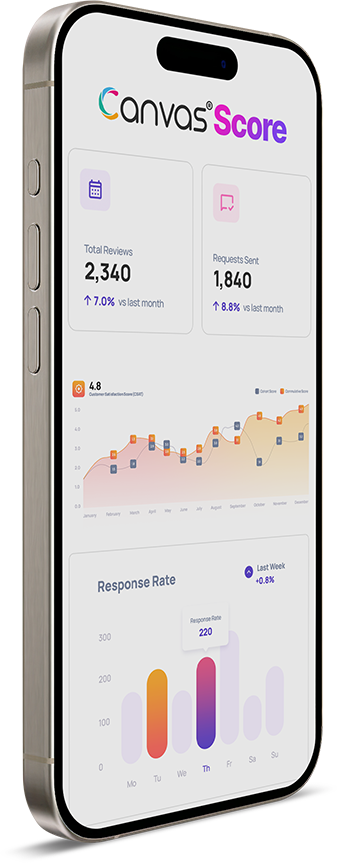
Reputation Intelligence Dashboard: See exactly how many reviews you have, monitor your growth over time, and keep a pulse on your overall sentiment to stay ahead of the local competition.
SEO-Friendly Embed Widget: Instantly stream your fresh 5-star Google reviews directly onto your website to boost your on-page SEO.
AI-Powered Replies: Engage with every review without wasting your valuable time. Google rewards businesses that respond to feedback, and our AI can draft professional replies for you in seconds.
Stop counting reviews and start automating them. Start your 14-day free trial with Canvas® Score today and turn a steady stream of feedback into your biggest SEO advantage.
Canvas® Score, the latest innovation from Roya.com — trusted by thousand of healthcare practices

Canvas® Score is a proprietary review & referral automation platform designed and developed by Roya.com
© 2026 Canvas® Score | All Rights Reserved